
Droit de prêt
Les principes généraux
Les dispositions relatives au droit de prêt en bibliothèque résultent de la loi du 18 juin 2003, dont les principaux objectifs étaient les suivants :
- permettre aux auteurs et aux éditeurs d’être légitimement rémunérés au titre du prêt de leurs livres en bibliothèque ;
- instituer et soutenir un régime de retraite complémentaire pour les auteurs de livres (écrivains, traducteurs, illustrateurs…) ;
- consolider l’action des bibliothèques en faveur de la lecture publique, en dispensant leurs usagers du paiement d’un droit de prêt ;
- soutenir la chaîne du livre, en favorisant l’accès des librairies aux marchés publics.
La loi a donc, d’une part, institué une licence légale relative au prêt d’ouvrages, permettant ainsi aux auteurs et aux éditeurs de bénéficier d’un droit à rémunération en contrepartie du prêt de leurs livres par les bibliothèques et à ces bibliothèques de prêter des livres sans porter atteinte au droit d’auteur. Elle a créé, d’autre part, un régime de retraite complémentaire pour les auteurs, financé partiellement par les sommes issues du droit de prêt, et, enfin, apporté un soutien accru à la librairie par le plafonnement des rabais pouvant être consentis sur les livres vendus aux bibliothèques de prêt.
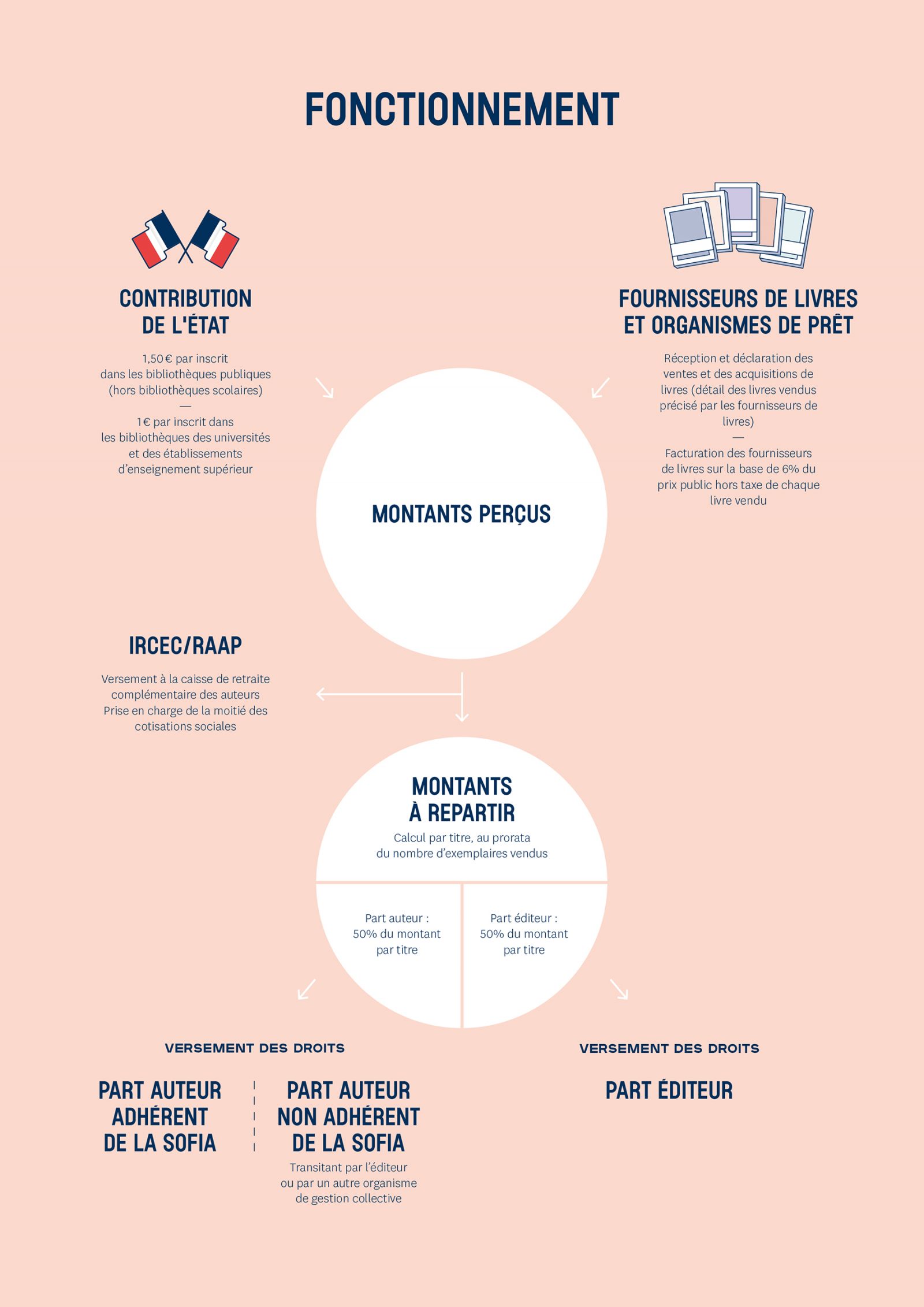
La rémunération pour le prêt des livres, au bénéfice de leurs auteurs et de leurs éditeurs, est financée en partie par l’État et en partie par les ventes de livres aux bibliothèques.
Les bibliothèques et centres de documentation assujettis au droit de prêt, ainsi que leurs fournisseurs de livres, doivent ainsi procéder aux déclarations de leurs achats ou de leurs ventes de livres auprès de la Sofia. Les fournisseurs de livres reversent, sur la base de ces déclarations, une redevance correspondant à 6% du prix public hors taxe des livres vendus aux organismes de prêt. L’État, quant à lui, verse à la Sofia une contribution calculée sur le nombre d’usagers inscrits dans les bibliothèques de lecture publique et les bibliothèques universitaires.
La perception des droits
Les organismes de prêt et les fournisseurs de livres à ces organismes doivent chaque année communiquer à la Sofia les informations relatives à leurs acquisitions ou à leurs ventes de livres. Ces déclarations permettent à la Sofia de percevoir les sommes dues par les fournisseurs, mais également de répartir très exactement les droits aux auteurs et aux éditeurs de ces livres. La répartition du droit de prêt est en effet calculée sur la base des exemplaires achetés par titre et non sur le nombre de prêts intervenus par titre.
En 2024, le total des redevances perçues auprès des fournisseurs de livres s’est élevé à 7,21 M€ et la contribution de l’État à 10,78 M€, soit un montant total de perception de 17,99 M€.
La distribution des droits
La Sofia répartit chaque année l’ensemble des droits aux auteurs et aux éditeurs, après en avoir reversé une partie au profit des auteurs affiliés au régime de retraite complémentaire des auteurs de livres (IRCEC/RAAP).
Le montant total des droits répartis en 2024 et distribués aux auteurs et aux éditeurs en mars 2025 s’est élevé à 12,71 M€ et un montant de 6,71 M€ a été affecté au régime de retraite complémentaire des auteurs de livre.
Les droits sont partagés, pour chaque ouvrage, par moitié entre l’auteur et l’éditeur.
Les adhérents de la Sofia peuvent consulter en ligne, dans leurs espaces privés, le montant des droits correspondant aux livres dont ils sont les auteurs ou les éditeurs.
Pour les non-adhérents, un moteur de recherche sur le site de la Sofia permet de savoir si leurs titres sont ou non bénéficiaires du droit de prêt.
Le droit de prêt à l’étranger
Le droit de prêt existe dans onze pays européens. Il est, en général, à la charge de l’État ou des collectivités locales et, plus rarement, du lecteur. En vertu des accords passés avec des organismes de gestion collective étrangers, les auteurs des livres traduits et empruntés dans les bibliothèques de ces pays perçoivent à ce titre des droits de la Sofia.
Des accords de réciprocité existent avec PLR (Royaume-Uni), ALCS (Royaume-Uni), Authors Registry (Etats-Unis), Cedro (Espagne), Proliterris (Suisse), Stichting Pro (Pays-Bas), Lira (Pays-Bas), VGWort (Allemagne), ICLA (Irlande), Litterar Mechana (Autriche), Alis (Suède), Reprobel (Belgique), Copibec (Québec) et CDR (Colombie).
Historique des montants nets répartis par la Sofia
| Montant total distribué | Montant réparti aux auteurs et aux éditeurs | Montant affecté aux cotisations (RAAP) | |
| 2012 | 15,1 M€ | 13,5 M€ | 1,6 M€ |
| 2013 | 14,5 M€ | 12,8 M€ | 1,7 M€ |
| 2014 | 14,6 M€ | 12,6 M€ | 2,0 M€ |
| 2015 | 15,1 M€ | 12,9 M€ | 2,2 M€ |
| 2016 | 14,8 M€ | 12,1 M€ | 2,7 M€ |
| 2017 | 14,5 M€ | 11,7 M€ | 2,8 M€ |
| 2018 | 14,5 M€ | 11,7 M€ | 2,8 M€ |
| 2019 | 14,9 M€ | 11,0 M€ | 3,9 M€ |
| 2020 | 15,0 M€ | 11,4 M€ | 3,6 M€ |
| 2021 | 26,1 M€ | 22,1 M€* | 4,0 M€ |
| 2022 | 16,5 M€ | 12,6 M€ | 3,9 M€ |
| 2023 | 17,6 M€ | 12,7 M€ | 4,9 M€ |
| 2024 | 19,4 M€ | 12,7 M€ | 6,7 M€ |
ayant notamment permis un rattrapage important sur les années antérieures.
> Fournisseur de livres, cliquez ici pour savoir comment faire vos déclarations
> Organisme de prêt, cliquez ici pour savoir comment faire vos déclarations
Pour en savoir plus